
Getting inventory into Amazon’s fulfilment network is about more than booking a shipment. Every unit has to meet Amazon’s FBA prep requirements before it arrives, or it risks being rejected, delayed or charged for extra handling. That matters even more now, because in the US Amazon has stopped offering its own prep and item labelling services.
This guide explains what changed, the core prep and labelling rules, carton requirements, and how to brief your supplier or freight forwarder so your shipments arrive ready to receive.
What Changed in 2026
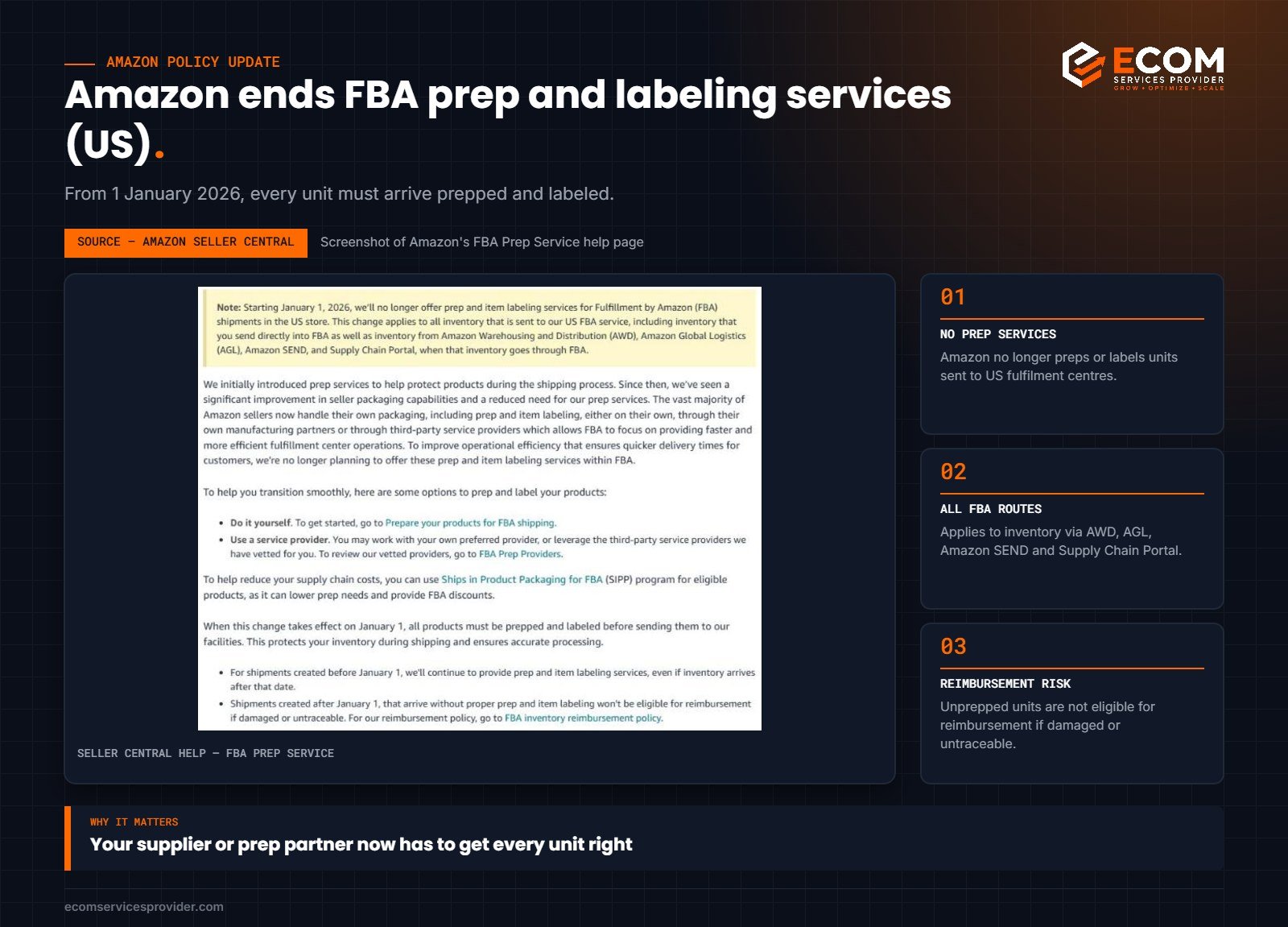
From 1 January 2026, Amazon ended its FBA prep and item labelling services for US shipments. Previously, sellers could pay Amazon to apply barcodes or polybag items on arrival. Now, all prep and labelling must be completed before inventory reaches Amazon.
In practice, this means every unit you send must arrive correctly labelled, packaged and compliant. If you were relying on Amazon to fix prep issues at the warehouse, you’ll need a new plan: your supplier, an in-house team or a third-party prep centre.
Rules can differ between marketplaces, so if you sell in the UK, EU or elsewhere, check the current requirements for each one in Seller Central.
Core FBA Prep Requirements
Barcodes and FNSKU labels
Each unit needs a scannable barcode that Amazon can use to identify it. Most sellers use an FNSKU label, the Amazon-specific barcode generated in Seller Central for each product. Key rules:
- Print labels clearly so they scan first time. Smudged or faded labels cause problems.
- Place the label on a flat surface where it won’t wrap around corners or curves.
- Cover any other scannable barcodes on the unit (such as a manufacturer UPC), so the wrong code isn’t scanned.
- Use labels that can be removed without leaving residue, where possible.
Some products may qualify to use the manufacturer barcode instead of an FNSKU, but this depends on your account and product, and isn’t suitable if you want to keep your inventory separate from other sellers’.
Polybagging
Items that could be damaged by dust or moisture, or that come in loose or soft packaging (such as clothing or textiles), often need to be placed in a polybag. Requirements typically include:
- Transparent bags so the barcode can be scanned through them, or the label applied on the outside
- A minimum bag thickness set by Amazon
- A suffocation warning printed on, or attached to, bags with larger openings
- Bags sealed so the product can’t slip out
Fragile and breakable items
Glass, ceramics and other fragile products need protective packaging, such as bubble wrap or a sturdy box, so they survive handling and a drop test. Products should be fully enclosed with no exposed fragile edges.
Liquids, sharp items and special categories
Liquids need caps secured and often need to be bagged to contain leaks. Sharp items must be fully covered so they can’t injure anyone. Some products, such as hazardous materials (dangerous goods), have extra review and labelling requirements. Always check the category-specific rules.
Sets and bundles
If several items are sold as one unit, they must be packaged together so they can’t separate in the warehouse, and clearly marked as a set (for example “Sold as set, do not separate”). Individual barcodes on the components should be covered so only the set barcode can be scanned.
Carton and Shipment Requirements
Amazon also has rules for the boxes that carry your products. For standard US shipments, the most common include:
- Weight: cartons should generally stay under 50 lb (about 23 kg), unless a single item in the box is heavier, in which case it needs clear heavy-package labelling.
- Dimensions: no side of a standard carton should exceed 25 inches (about 63.5 cm), unless the item itself is larger.
- Box content information: you need to provide what’s in each carton, either in the shipment workflow or using box labels.
- Shipping labels: each carton needs its own FBA shipment label, placed so it isn’t over a seam or edge.
- Packaging quality: use sturdy boxes with suitable dunnage (filler) so products don’t move around.
Pallet shipments have their own rules for height, weight and labelling, so check those if you’re sending larger volumes.
Choosing a Prep Model
With Amazon no longer prepping US inventory, most sellers choose one of three approaches:
- Supplier prep. Your manufacturer labels and packs each unit before it leaves the factory. It’s usually the most cost-effective option, but it depends on clear instructions and a reliable quality check.
- In-house prep. You or your team receive stock and prepare it yourselves. This gives you full control, but takes space, time and labour.
- Third-party prep centre. A specialist receives your goods, inspects, labels and packs them, then sends them to Amazon. You pay per unit or service, and gain an extra inspection step.
Many sellers mix these: supplier prep for simple, high-volume SKUs and a prep centre for fragile or complex items. Whatever you choose, document the prep rules for every SKU so nothing depends on memory.
How to Brief Your Supplier or Freight Forwarder
If your products ship directly from a manufacturer or a forwarder to Amazon, they need clear instructions. A good prep brief includes:
- The FNSKU labels for each SKU, plus where to place them on the product.
- Prep instructions for each SKU: polybag, bubble wrap, set labelling or none.
- Carton instructions: units per carton, maximum weight and dimensions, and how to apply carton labels.
- Shipment details: the destination fulfilment centre(s) and shipment IDs from your shipment plan.
- A quality check step: ask for photos of a labelled unit and a packed carton before goods ship.
At ECOM Services Provider we don’t run a warehouse or store client stock, but as part of our Amazon FBA support we prepare these requirements for your supplier or forwarder, so they can get your shipment right first time.
Common FBA Prep Mistakes
- Uncovered manufacturer barcodes leading to the wrong product being scanned
- Labels placed on curved surfaces or across seams
- Missing suffocation warnings on polybags
- Oversized or overweight cartons
- Box contents not matching the shipment plan
- Fragile items packed without enough protection
Each of these can delay receiving and may lead to extra fees or blocked shipments. They can also affect your inventory performance and how much stock you’re able to send in future.
For Amazon’s own requirements, see Fulfillment by Amazon on Sell on Amazon and the packaging and prep pages in Seller Central.
Frequently Asked Questions
Does Amazon still label FBA products for sellers?
For US shipments, Amazon ended its prep and item labelling services from 1 January 2026, so sellers need to label and prep units before they arrive. Other marketplaces may differ, so check the rules where you sell.
What is an FNSKU?
An FNSKU is the Amazon fulfilment barcode linked to your seller account and product. It lets Amazon track your specific units in its fulfilment network.
Can my supplier prep my FBA inventory?
Yes. Many sellers ask their manufacturer to apply FNSKU labels and packaging before goods leave the factory. Give them a clear brief and ask for photos before shipping.
What happens if my shipment doesn’t meet prep requirements?
Amazon may delay receiving, charge for unplanned services where offered, return or dispose of non-compliant units, or limit future shipments. Getting prep right the first time avoids these costs.
Need Help With Your FBA Shipments?
With 8+ years of Amazon experience and 768+ completed projects, ECOM Services Provider helps sellers plan shipments and brief suppliers on FBA requirements. Learn more about our Amazon FBA and Amazon account management services, or book a free consultation.