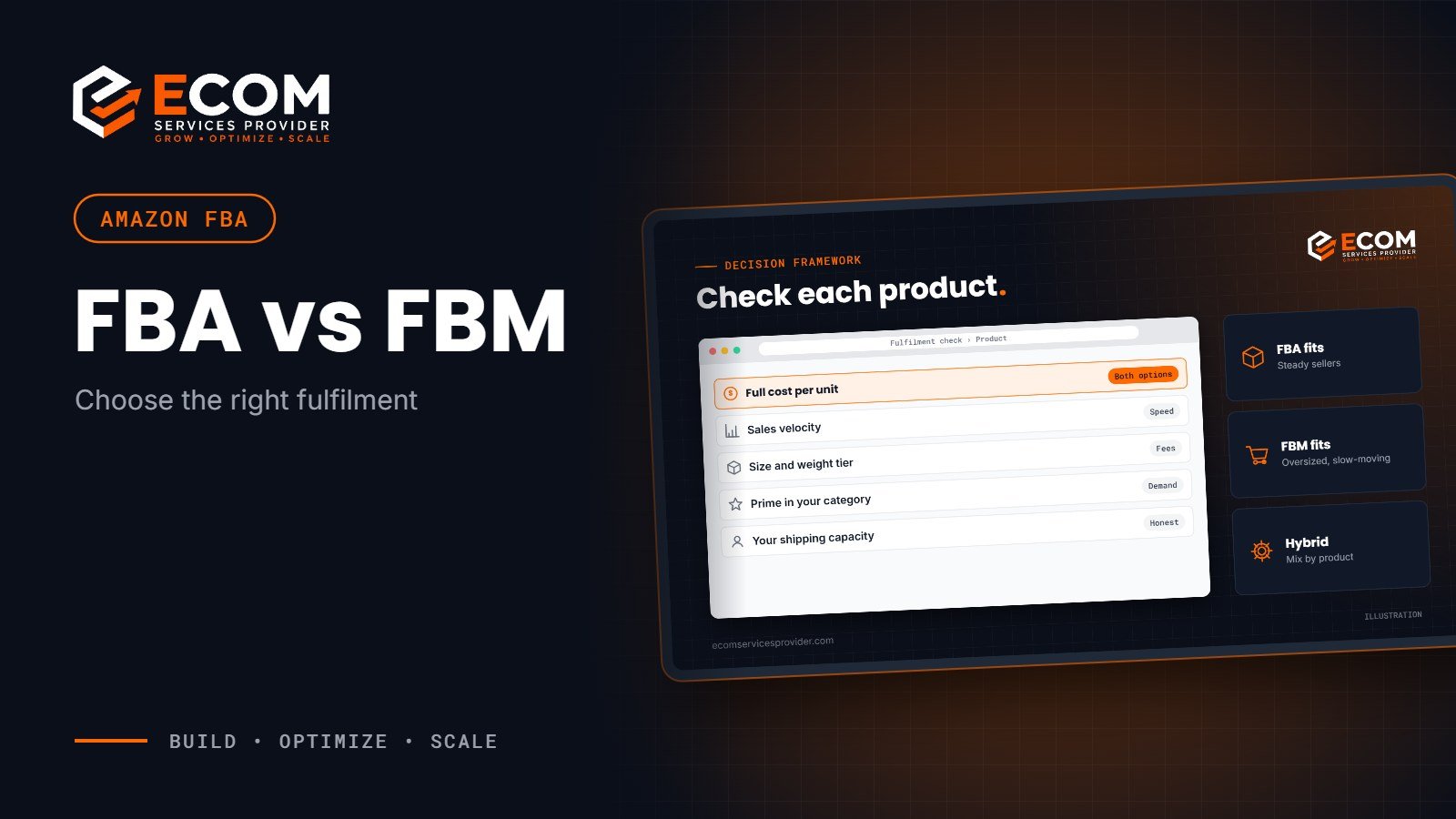
One of the biggest operational decisions an Amazon seller makes is who ships the orders. With Fulfilment by Amazon, Amazon stores, packs and delivers your products. With Fulfilment by Merchant, you do it yourself or through your own logistics partner. The Amazon FBA vs FBM decision affects your costs, your cash flow, your Prime eligibility and how much of your time goes into operations.
There is no single right answer. This guide compares the two models honestly, explains the costs and responsibilities on each side, and gives you a simple framework for choosing, including when a hybrid approach makes sense.
How FBA Works
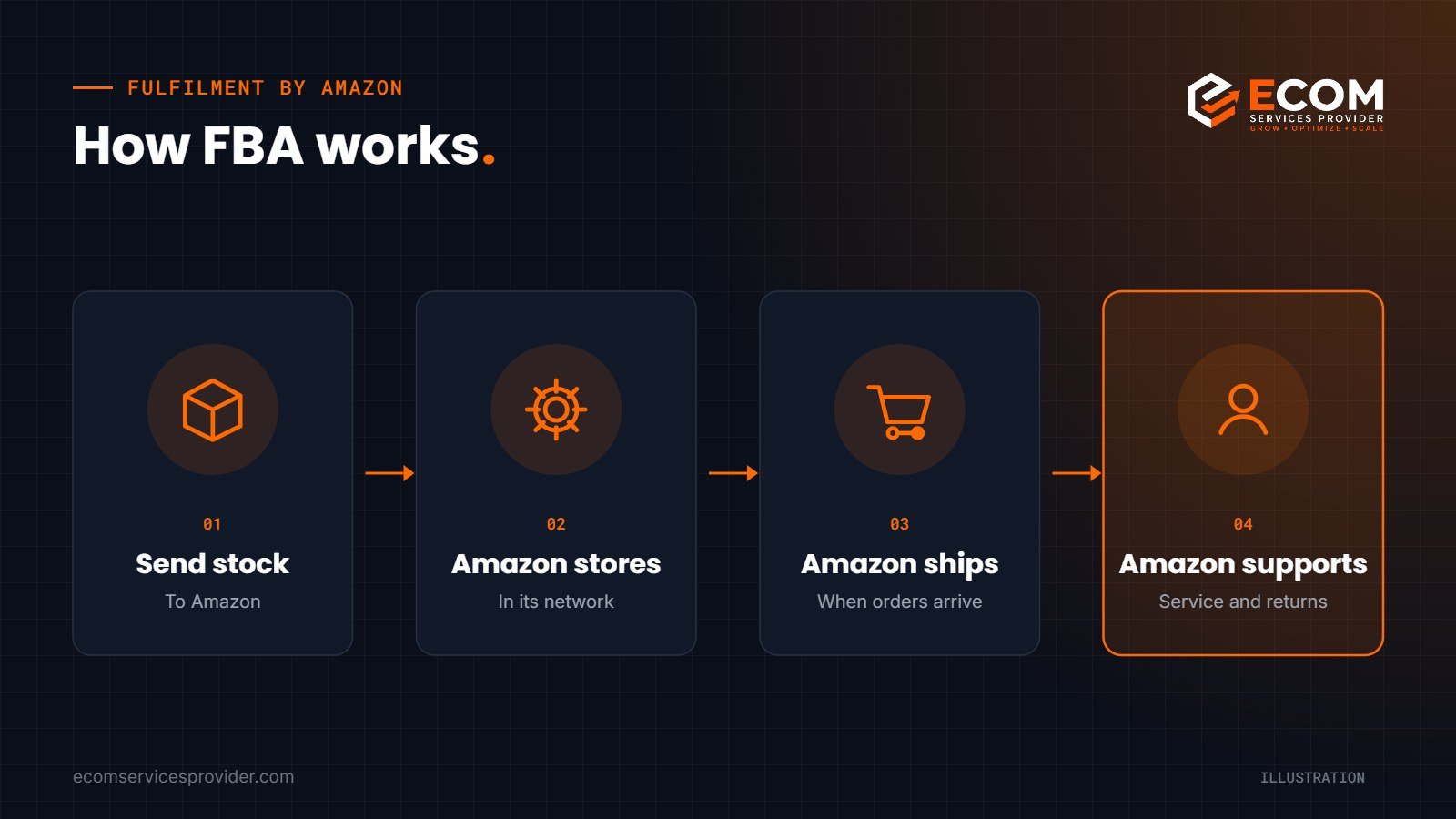
With Fulfilment by Amazon (FBA), you send inventory to Amazon’s fulfilment centres. When a customer orders, Amazon picks, packs and ships the item, and handles customer service and returns for those orders. FBA offers are generally eligible for Prime, which matters because many shoppers filter for, or prefer, Prime delivery.
You pay fulfilment fees per unit, monthly storage fees and, depending on your inventory and shipping choices, other charges such as fees linked to inbound placement, low inventory levels or long-term storage. Fee structures change regularly, so check Amazon’s current FBA fee information before you model your margins.
Your inventory also has to arrive prepared. In the US, Amazon ended its own prep and item labelling services from 1 January 2026, so every unit must now be labelled and packaged correctly before it reaches a fulfilment centre. Our guide to Amazon FBA prep requirements covers the rules.
How FBM Works
With Fulfilment by Merchant (FBM), you list products on Amazon but store and ship them yourself, from your own warehouse, a third-party logistics provider (3PL) or directly from a supplier where permitted. You are responsible for delivery times, tracking, customer service and returns, and your performance is measured against Amazon’s seller-fulfilled metrics.
FBM offers do not get the Prime badge by default. Some sellers qualify for Seller Fulfilled Prime, which lets them display Prime on self-fulfilled orders, but it comes with strict delivery and performance requirements.
Amazon FBA vs FBM: Side-by-Side Comparison
Costs
FBA costs are predictable per unit but include storage, which can become expensive for slow-moving or bulky items. FBM costs depend on your own warehousing, packaging, labour and shipping rates. For small, fast-selling products FBA is often efficient; for large, heavy or slow-moving products FBM can work out cheaper.
Customer experience
FBA gives you Amazon’s delivery speed and Prime eligibility, plus Amazon-managed returns. FBM can match this only if your own logistics are fast and reliable. Returns are worth thinking about too: with FBA, Amazon processes returns for you, but you have less say over how returned units are assessed. With FBM, you handle returns yourself, which takes time but lets you inspect, refurbish or resell items as you see fit.
Control
FBM gives you full control over packaging, inserts, stock and shipping choices. FBA gives you less control but takes the day-to-day workload off your hands.
Cash flow and inventory
With FBA, stock sits in Amazon’s network, often spread across several locations, and you need enough inventory to cover inbound lead times. With FBM, stock stays with you, which can make it easier to sell the same units across several channels.
Account health
Both models are measured. FBA removes most shipping-related metrics from your responsibility, while FBM sellers must manage late shipment rate, valid tracking and cancellation rate closely to protect their account health.
When FBA Usually Makes Sense
- Small to medium-sized products that sell steadily
- Products in categories where Prime delivery strongly influences buying decisions
- Brands that want to spend time on marketing and product development rather than logistics
- Sellers without their own warehouse or reliable 3PL
When FBM Usually Makes Sense
- Oversized, heavy or fragile products with high FBA fees or special handling needs
- Slow-moving or seasonal products where storage fees would eat into margins
- Made-to-order, personalised or bundled items that need custom packing
- Sellers who already run efficient fulfilment for other channels
The Hybrid Approach
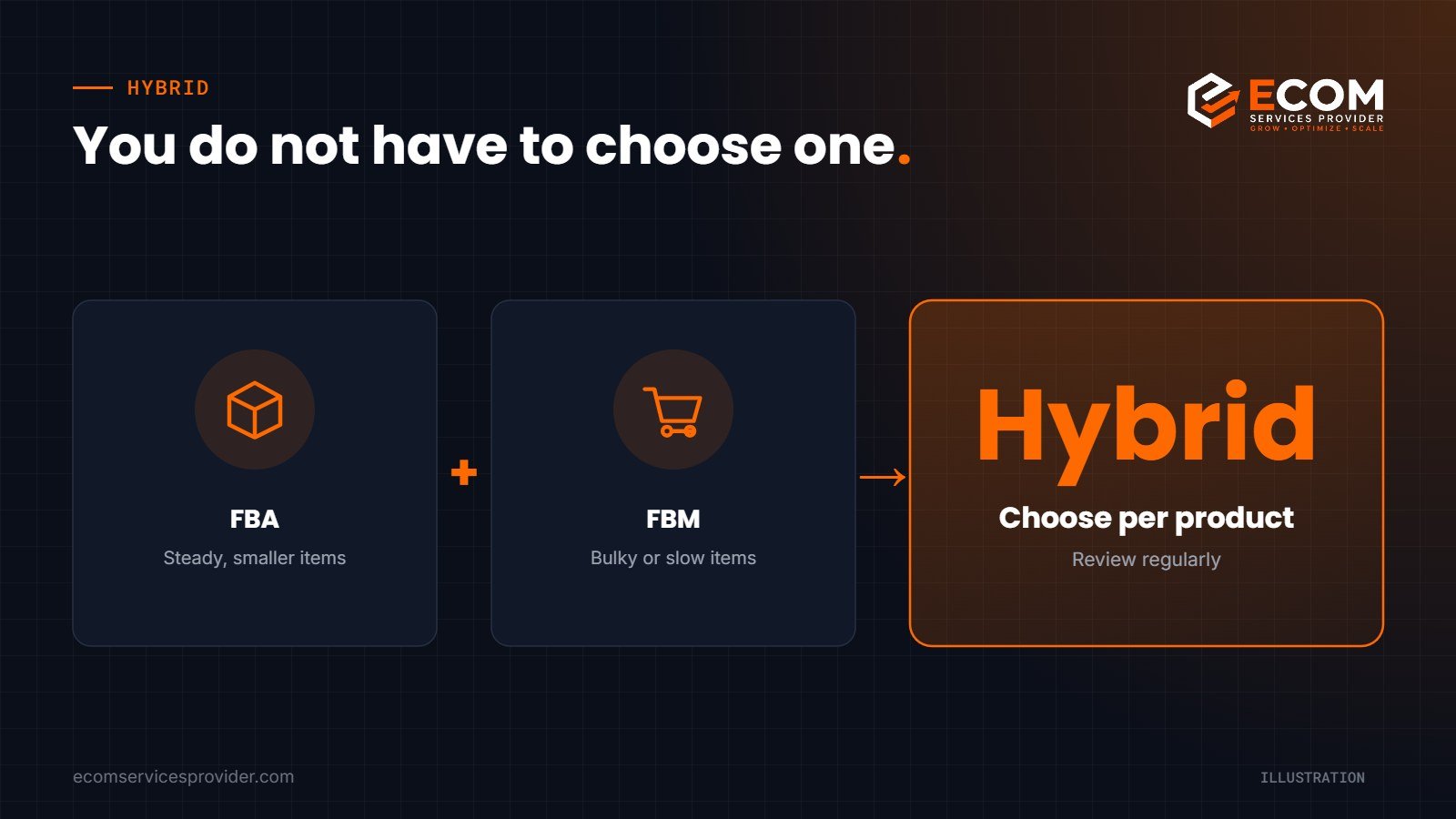
Many established sellers use both. A common setup is to run FBA for core, fast-moving products and FBM for bulky or slow items. Some sellers also keep an FBM offer active on key products as a backup, so they can keep selling if FBA stock runs out or inbound shipments are delayed. If you do this, make sure your own stock levels and shipping settings are accurate, because late or cancelled FBM orders still affect your account.
How to Decide: A Simple Framework
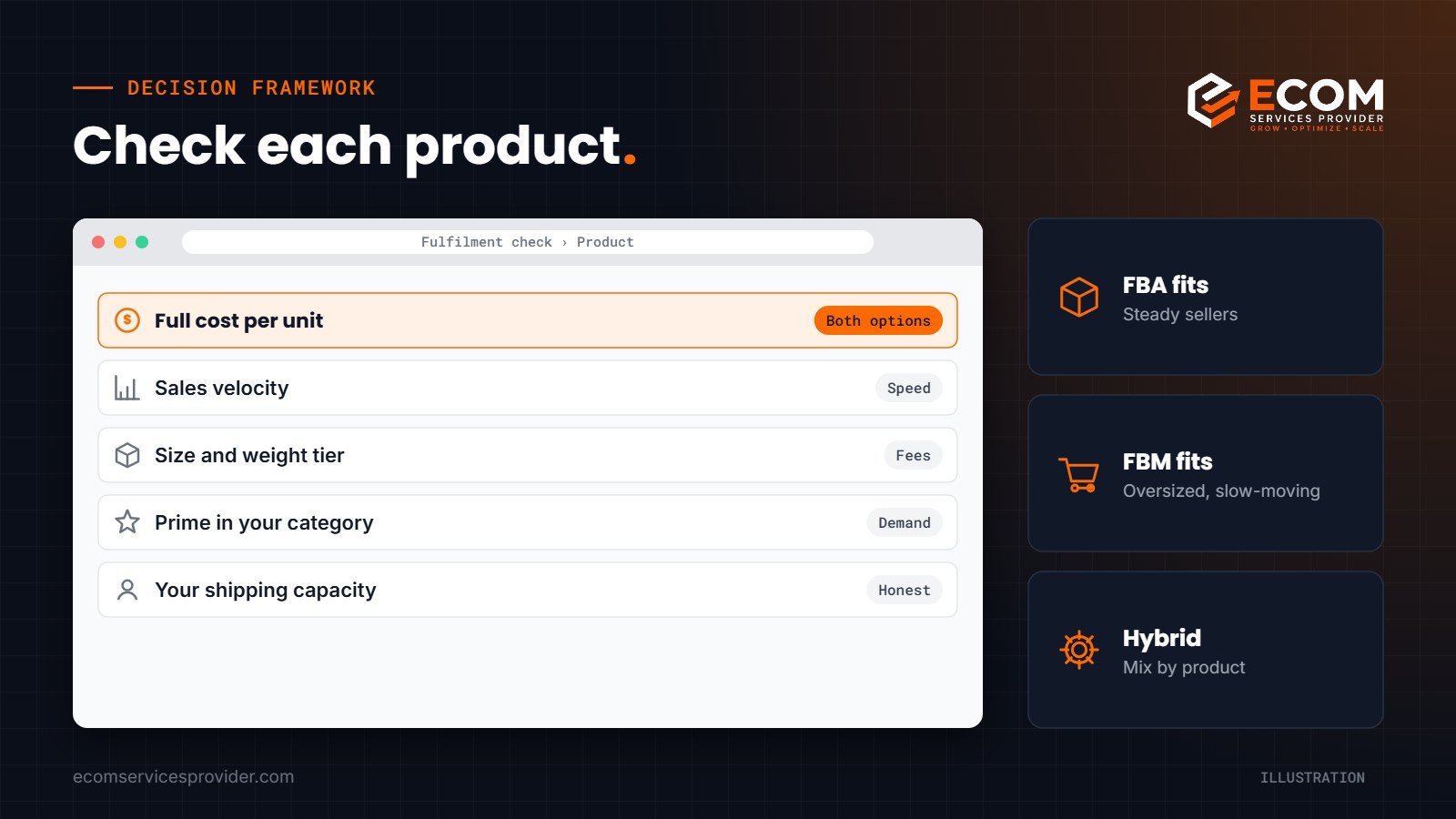
- Calculate the full cost per unit for both options, including storage, packaging, labour and returns, not just the fulfilment fee.
- Estimate sales velocity. The faster a product sells, the less storage cost matters.
- Check size and weight tiers. Oversized items often change the comparison completely.
- Consider Prime’s impact in your category by looking at how many top-ranking competitors offer Prime delivery.
- Be honest about your capacity. If you cannot ship reliably and quickly every day, FBA protects your customer experience.
- Review regularly. Fees, volumes and product ranges change, so revisit the decision at least once or twice a year.
How We Do It at ECOM Services Provider
When we help a seller choose between FBA and FBM, we start with the numbers. We list each product with its dimensions, weight, sales velocity and current fulfilment set-up, then compare the realistic cost of each option using Amazon’s current fee information and the seller’s own shipping and warehousing costs. We also review competitor offers to see how important Prime delivery is in the category.
From there, we recommend a model product by product, often a mix of the two, and help set it up: creating FBA shipments and briefing suppliers on prep and labelling, or configuring shipping templates and handling times for FBM. Our team has 8+ years of Amazon experience and 768+ completed projects, and we keep an eye on fee and policy changes so the set-up stays right over time.
Frequently Asked Questions
Is FBA more profitable than FBM?
Not automatically. FBA often increases conversion through Prime eligibility, but fees and storage costs can reduce margins on some products. Compare the full cost per unit for each option.
Can I switch a product from FBM to FBA?
Yes. You can convert an existing offer to FBA in Seller Central and then create a shipment to send inventory to Amazon. You can also switch back to FBM if needed.
Does Amazon favour FBA listings in search?
Amazon does not publish a ranking advantage for FBA as such. However, factors linked to FBA, such as fast delivery, Prime eligibility and strong conversion, can help your products perform well.
Can I use FBA and FBM for the same product?
Yes. Many sellers keep both offers on the same product so they can keep selling if FBA stock runs low.
Choose the Right Fulfilment Model
FBA vs FBM is not a one-off choice; it is a decision worth reviewing as your business grows. Our Amazon FBA service covers shipment planning, prep guidance and inventory management, and our Amazon account management service keeps fulfilment, listings and account health running smoothly.
Book a free consultation to review your fulfilment set-up.