Choosing the wrong product is the most expensive mistake an Amazon seller can make. Stock, photography, listing copy and advertising all cost money, and none of it can rescue a product nobody is searching for. Good Amazon product research reduces that risk by testing an idea against real demand, real competition and real numbers before you commit.
This guide walks through the research process we use with clients, step by step, so you can judge any product idea with the same structure.
What Good Amazon Product Research Answers
Every product idea should be able to answer five questions:
- Is there demand? Are shoppers actively searching for and buying this type of product?
- Can you compete? Are the top listings beatable on quality, content or offer, or are they locked up by dominant brands?
- Which keywords matter? What exactly do shoppers type, and how much search volume sits behind those terms?
- Is it profitable? After product cost, shipping, Amazon fees and advertising, is there a healthy margin left?
- Is it safe to sell? Are there restrictions, certifications, patents or high return risks that could cause problems later?
If an idea fails any one of these, it is usually better to move on early than to discover the problem after the first order.
Step 1: Start With Demand Signals
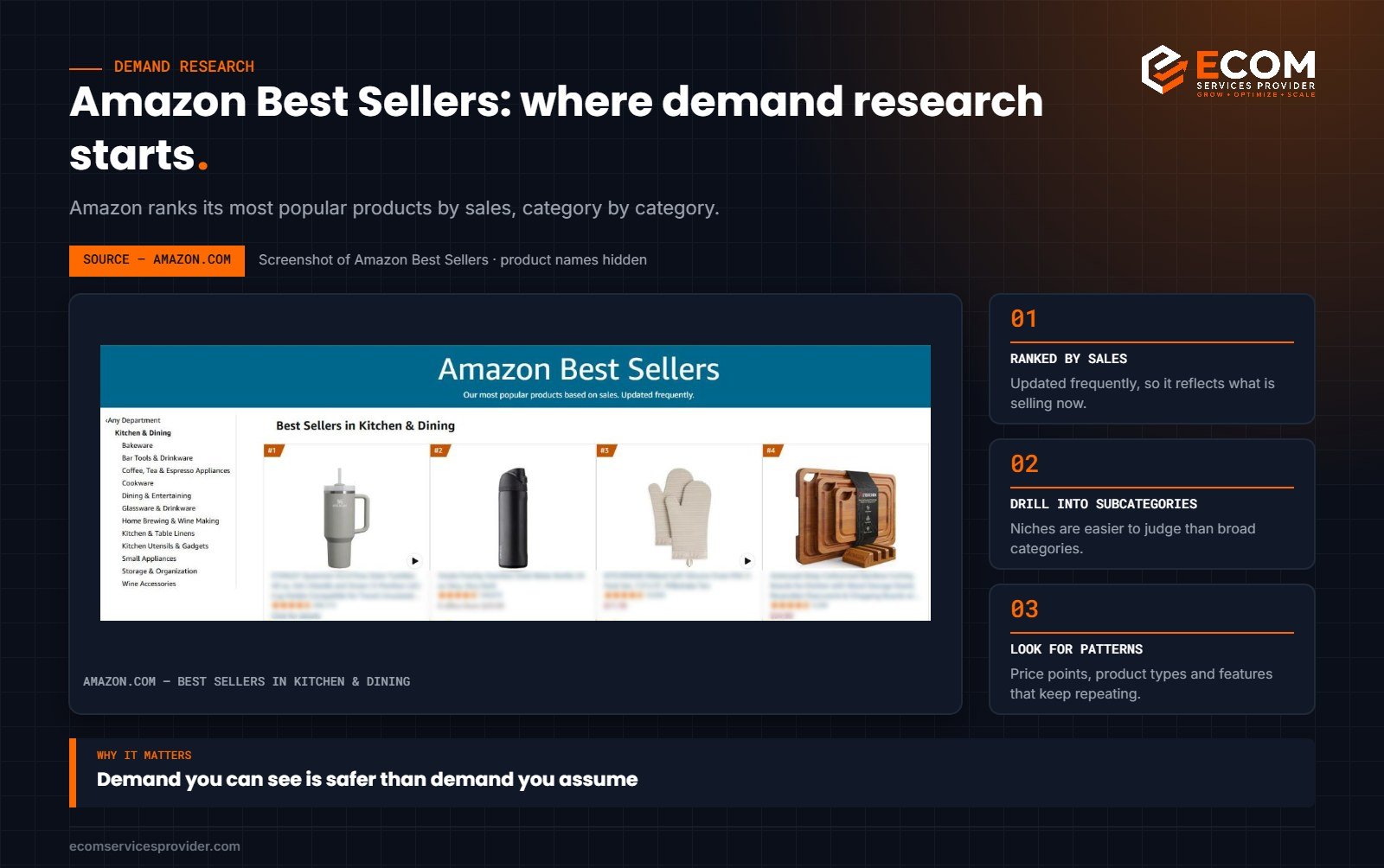
Amazon itself is the best place to start. The Best Sellers pages rank the most popular products in each category based on sales, and they are updated frequently. Browsing a category and its subcategories shows you what is selling now, how crowded each niche is, and where shoppers are spending.
Look beyond the top few products. Scroll through the top 50 and note patterns: price points that keep appearing, product types that dominate, and features that many top sellers share. Then check the Best Seller Rank (BSR) on individual product pages. A consistent rank over time is a better signal than a single spike.
Step 2: Turn the Idea Into Keywords
Demand on Amazon is expressed through searches, so the next step is keyword research. Build a list of every term a shopper might use for the product: the core product name, materials, sizes, use cases and audiences. Then add search volume to each term using a keyword tool.
This tells you two things. First, whether there is enough total search demand to support the sales you need. Second, which specific terms your listing would have to rank for. A product with one huge keyword and nothing else behind it is riskier than one with a healthy spread of relevant terms.
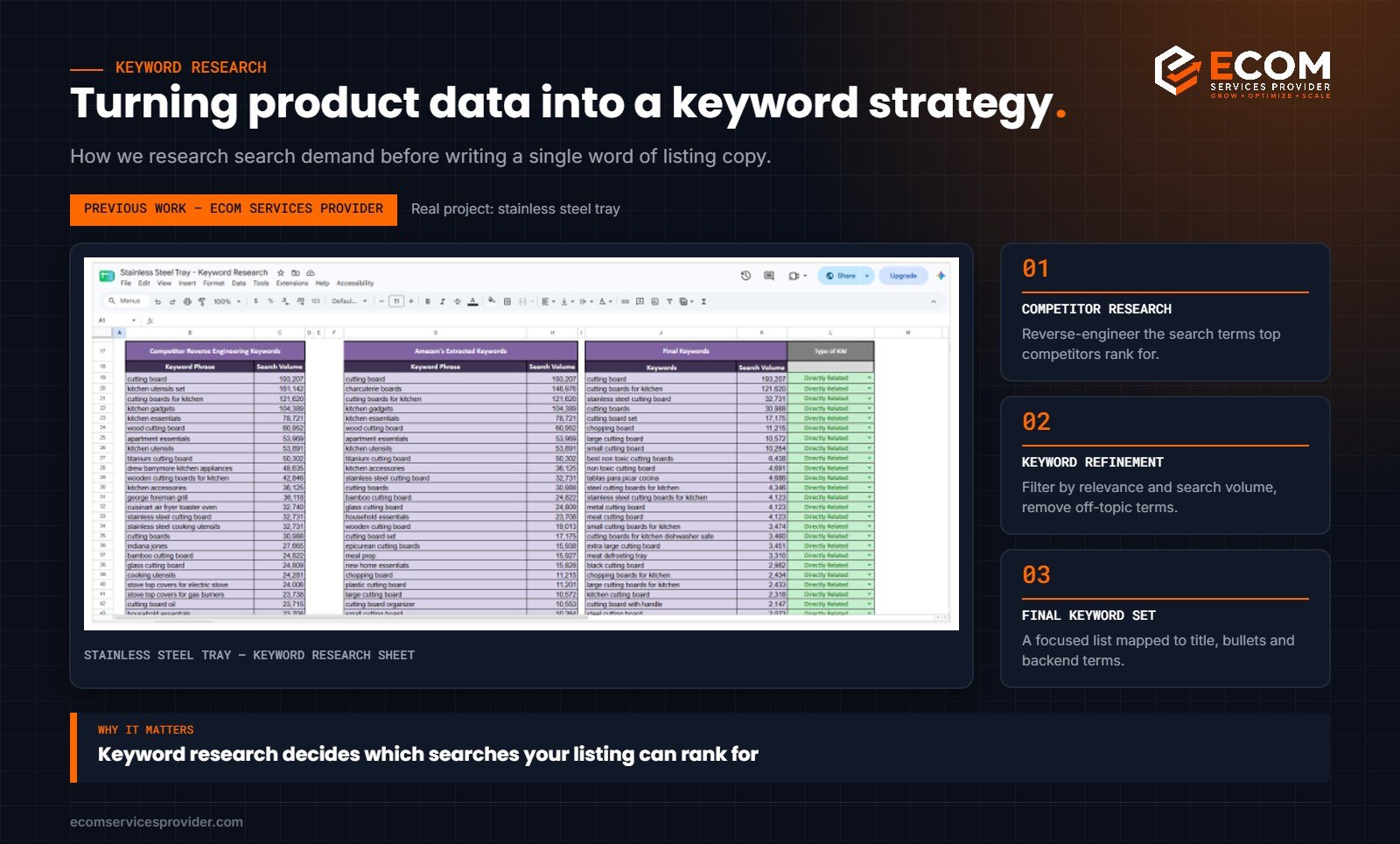
This is what the keyword step looks like in practice: competitor keywords on the left, Amazon’s own extracted search terms in the middle, and the final, relevance-checked list on the right, each with its search volume.
Step 3: Study the Competition
Search your main keywords and study page one. For each of the top listings, note:
- Price, rating and number of reviews
- How strong the images, title and A+ Content are
- What customers praise and complain about in reviews
- Whether the same brand appears again and again
Weak listings with poor images and thin copy are an opportunity, because better content can win clicks and conversions. Page-one results filled with listings that have tens of thousands of reviews and strong brands are much harder to break into.
Negative reviews are especially valuable. They show you what shoppers wish the product did better, and that can shape your own product or your listing.
Step 4: Check the Numbers
Before anything else, build a simple profit model:
- Landed cost per unit: product cost plus shipping and duties
- Amazon fees: referral fee and fulfilment fees for your size and weight tier
- Advertising: a realistic advertising cost per sale, especially during launch
- Returns and discounts: an allowance for returns, coupons and promotions
If the margin only works with zero advertising and no returns, the product is too tight. Leave room for the costs of launching and staying visible.
Step 5: Run Risk Checks
Finally, check for anything that could stop you selling:
- Category restrictions or approval requirements
- Required safety certifications or compliance documents
- Patents, trademarks or design rights held by others
- Fragile, oversized or hazardous items that complicate fulfilment and FBA prep
- Seasonality that could leave you with stock out of season
How We Do It at ECOM Services Provider
Our product research combines all of these steps in one structured sheet. We start from category demand, build and score the keyword list, review page-one competitors, and only then look at margins and risks. The same keyword research becomes the foundation for the listing later, so nothing is wasted.
A Worked Example: Validating a Kitchen Product
Imagine you are considering a stainless steel cutting board. Here is how the five questions play out in practice.
Demand: the kitchen Best Sellers pages show cutting boards appearing regularly, and individual listings hold steady ranks over several weeks rather than spiking once.
Keywords: the keyword sheet shows strong volume behind the core term, plus a healthy spread of related searches such as double-sided, with handle, for meat and dishwasher safe. That spread means a well-written listing can rank for many terms, not just one.
Competition: page one is a mix of large brands and smaller sellers. Several competing listings have weak images and generic bullets, and their reviews mention boards that stain or slip on the counter. Those complaints point to features and messages a new listing could lead with.
Numbers: after product cost, shipping, Amazon fees and a realistic launch advertising budget, the margin still holds at the target price.
Risks: no restricted category, no certification hurdles beyond standard food-contact materials, and a product that is easy to pack for FBA.
The idea passes all five checks, so it moves forward. The same keyword sheet then becomes the brief for the listing copy and images, which is exactly how research and optimisation should connect.
Common Product Research Mistakes
- Chasing trends without checking consistency. A sudden spike can disappear just as quickly.
- Ignoring advertising costs. Most new products need ads to gain traction.
- Copying a top seller exactly. Without a better product or better content, there is no reason for shoppers to choose you.
- Skipping the keyword step. Without keywords, you cannot predict whether shoppers will find you.
- Forgetting about fulfilment. Size, weight and prep needs affect both fees and logistics.
For Amazon’s own guidance on getting started, see the Sell on Amazon learning resources.
Frequently Asked Questions
How long does Amazon product research take?
A first pass on an idea can take a few hours. A full validation, including keyword research, competitor review and a profit model, usually takes a few days per product.
Is a low Best Seller Rank always good?
A low number means stronger recent sales, but it can also mean heavy competition. Use BSR as one signal alongside reviews, keyword volume and margins.
Do I need paid tools for product research?
Amazon’s Best Sellers pages and search results are free and very useful. Keyword tools add search volume data, which makes decisions far more reliable.
Can product research help existing sellers?
Yes. The same process helps you choose new variations, expand into related products or decide which items in your range deserve more investment.
Want Help Choosing Your Next Product?
ECOM Services Provider has 8+ years of Amazon experience and has completed 768+ projects for sellers across Amazon marketplaces worldwide. Our Amazon product research service covers demand, keywords, competition and margins, and our listing optimization team turns that research into a listing that converts. Book a free consultation to talk through your ideas.