If you advertise on Amazon, one number shows up in every report and every conversation about profit: ACOS. Understanding Amazon ACOS properly, including what a “good” figure looks like for your products, is the difference between ads that build a business and ads that quietly drain it.
This guide explains how ACOS is calculated, how it relates to ROAS and TACoS, how to work out your break-even point, and the practical steps that bring it down.
What Is Amazon ACOS?
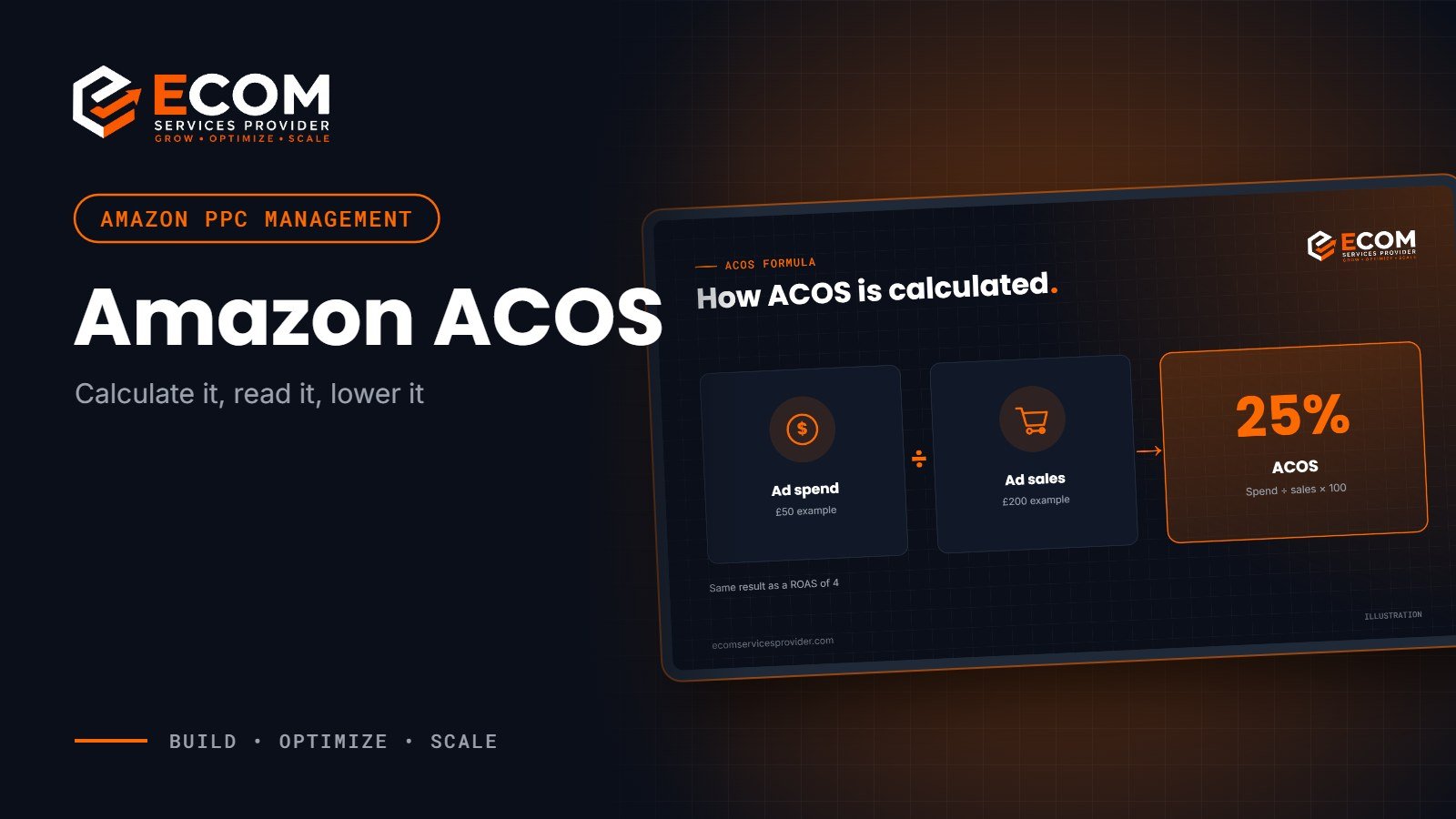
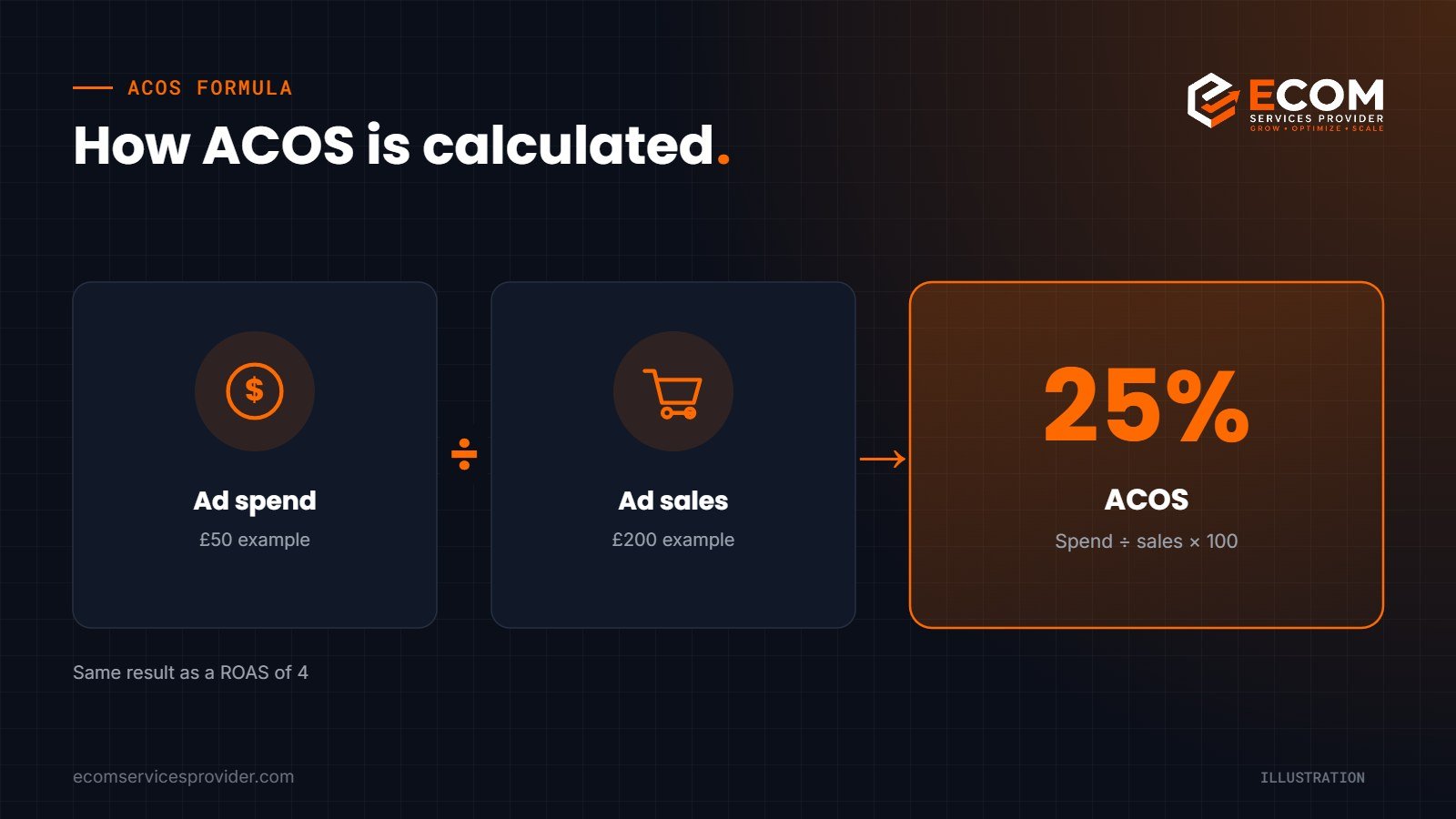
ACOS stands for advertising cost of sales. It shows how much you spend on ads for every unit of sales those ads generate. Amazon Ads defines the formula as:
ACOS = (ad spend ÷ ad revenue) × 100
For example, if you spend £50 on Sponsored Products ads and those ads generate £200 in sales, your ACOS is 25%. A lower ACOS means each pound of ad spend is bringing in more sales.
ACOS only measures sales that Amazon attributes to your ads. It does not include organic sales, which is why it should never be the only number you look at.
ACOS vs ROAS: Two Sides of the Same Metric
ROAS stands for return on ad spend. Amazon calculates it as ad revenue ÷ ad spend, which makes it the inverse of ACOS.
Using the same example, £200 in sales from £50 of spend gives a ROAS of 4. An ACOS of 25% and a ROAS of 4 describe exactly the same result.
Which you use is mostly preference. Sellers tend to think in ACOS because it compares easily with profit margins, while many advertisers outside Amazon are more used to ROAS. The important thing is to use one consistently across your reports.
What Is a Good ACOS?
Amazon is clear that there is no single definitive number for a good ACOS. The right target depends on your industry, margins, competition and goals. Amazon also notes that new campaigns often have a higher ACOS simply because they are new and still gathering data.
A good ACOS is one that matches what you are trying to achieve:
- Launching a product? A higher ACOS may be acceptable while you build sales history and reviews.
- Defending a best seller? You will usually want a lower, steadier ACOS.
- Building brand awareness? Sponsored Brands or Sponsored Display campaigns may run at a higher ACOS by design.
The figure only becomes meaningful when you compare it with your profit margin.
How to Calculate Break-Even ACOS
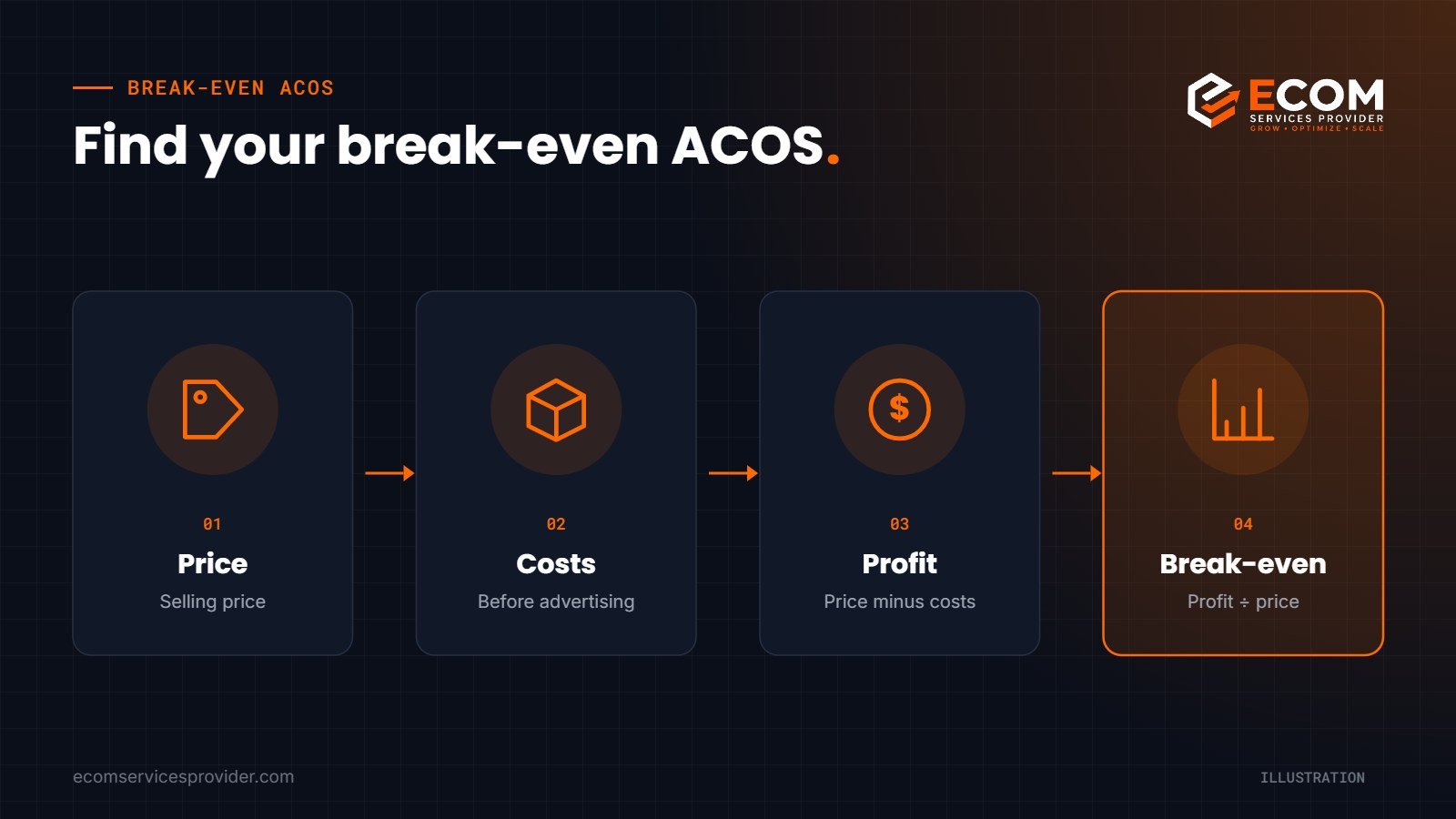
Amazon explains that break-even ACOS is directly linked to your profit margin. If your ACOS is higher than your margin, your ads cost more than they earn on those sales.
To work it out:
- Start with your selling price.
- Subtract all costs except advertising: product cost, Amazon fees, shipping, packaging and any other unit costs.
- What remains is your profit before advertising.
- Divide that profit by the selling price and multiply by 100.
The result is your break-even ACOS. For example, a product selling for £30 with £18 of costs before advertising leaves £12 profit, a 40% margin, so its break-even ACOS is 40%. Below 40%, the ads are profitable on those sales. Above it, they are losing money unless you are deliberately investing in growth.
TACoS: The Bigger Picture
TACoS, or total advertising cost of sale, divides your ad spend by your total sales, both from ads and organic. It shows how dependent your business is on advertising.
If your ACOS is stable but your TACoS is falling, your ads are likely helping to grow organic sales too, which is usually a healthy sign. If TACoS keeps rising, your sales may depend more and more on paid traffic.
How to Lower Amazon ACOS
Lowering ACOS is rarely about one big fix. It comes from steady work across your campaigns and your listings.
Cut wasted spend
Review your search term report regularly and add irrelevant or unprofitable searches as negative keywords. We cover this in detail in our guide to Amazon PPC negative keywords.
Adjust bids by performance
Lower bids on keywords and targets that spend without converting, and move budget to those with proven sales. Compare successful and weak campaigns to see where money should go.
Improve your listing
Ads send shoppers to your product page, but the page does the selling. Stronger images, clearer titles and bullets, and good A+ Content all improve conversion rate, which lowers ACOS without changing a single bid.
Structure campaigns for control
Separate exact, phrase and broad match and different product groups, so you can see what is working and adjust each part on its own.
Look beyond ACOS
Amazon advises that ACOS should not be your only campaign metric. Track impressions, click-through rate and conversion rate alongside it to understand why a campaign is performing the way it is.
Common ACOS Mistakes
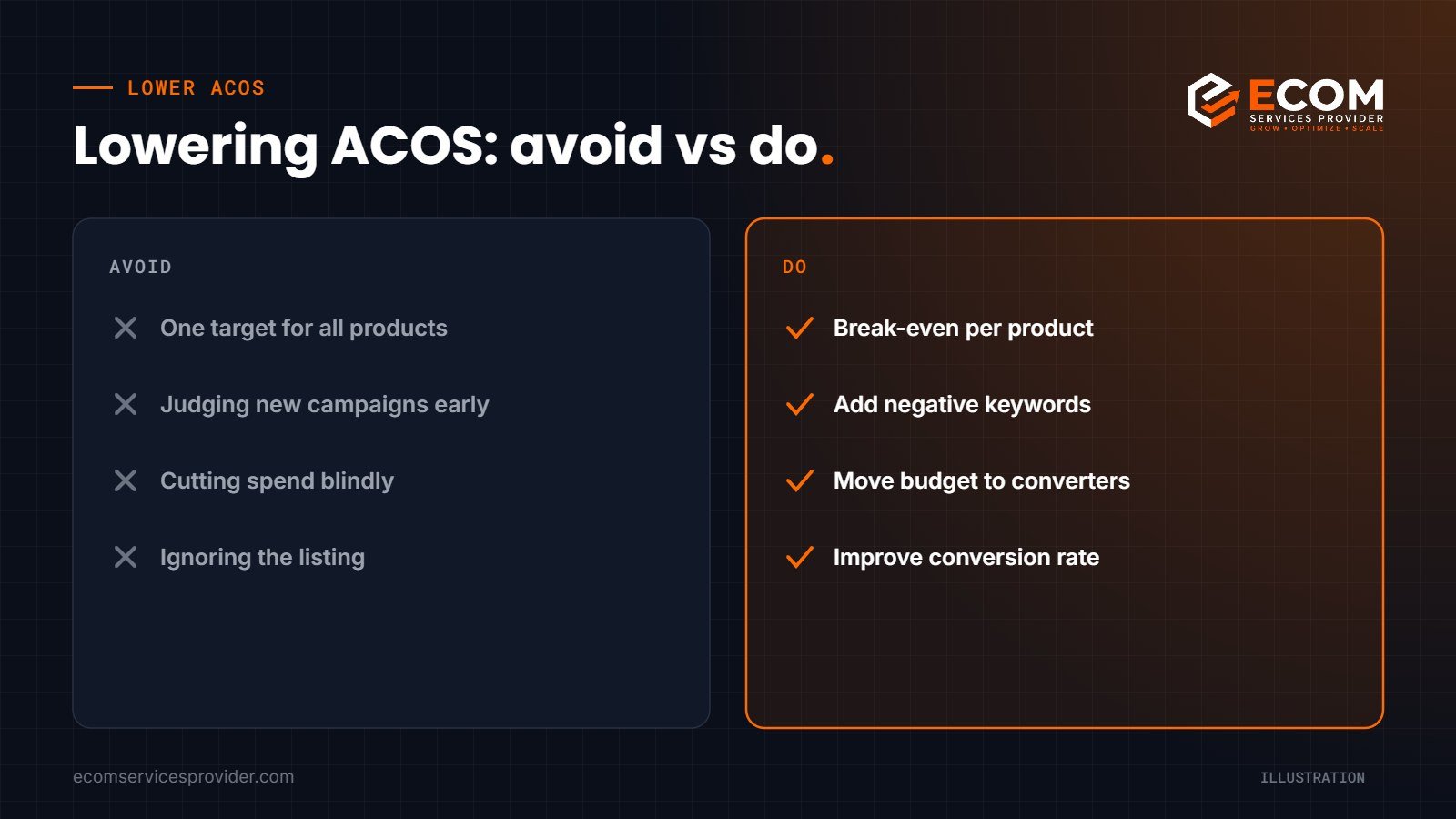
- Using one target for every product. Products with different margins need different break-even points. A 30% ACOS can be excellent on one item and loss-making on another.
- Cutting every high-ACOS keyword. Some keywords bring new customers who go on to buy again or leave reviews. Check the wider effect before switching them off.
- Judging new campaigns too soon. Give campaigns enough time and clicks to gather reliable data before making big changes.
- Chasing a lower ACOS at any cost. An ACOS that drops because you stopped spending may also mean fewer sales and lower rankings. Watch total sales and TACoS alongside it.
- Ignoring the listing. If shoppers click but do not buy, the problem is often the product page, not the bid.
How We Do It at ECOM Services Provider
Our founder is Amazon Ads Foundations Certified, and every PPC account we manage starts with the numbers behind ACOS. We calculate break-even ACOS for each product, agree a target based on the brand’s goals, and restructure campaigns so performance is easy to read. Each week we review search terms, add negatives, adjust bids and move budget towards what converts. We also review listings with our optimisation team, because a better product page is often the fastest way to a lower ACOS.
Frequently Asked Questions
What is a good ACOS on Amazon?
There is no single good ACOS. It depends on your margin and goals. To be profitable on ad sales, your ACOS needs to stay below your profit margin before advertising.
How do I calculate Amazon ACOS?
Divide your ad spend by the sales your ads generated, then multiply by 100. £50 of spend and £200 of ad sales gives an ACOS of 25%.
What is the difference between ACOS and ROAS?
They measure the same thing from opposite directions. ACOS is spend divided by sales, and ROAS is sales divided by spend.
Why is my ACOS so high?
Common causes are irrelevant search terms, bids that are too high, new campaigns still gathering data, and listings that do not convert the traffic they receive.
Ready to Bring Your ACOS Under Control?
ECOM Services Provider has 8+ years of eCommerce experience and has completed 768+ projects for brands worldwide. Our Amazon PPC management team sets profitable targets and lowers Amazon ACOS week by week, while our Amazon listing optimization service improves the pages your ads send shoppers to. Book a free consultation to talk through your campaigns.